Chronic Wasting Disease (CWD)
Effects the deer and elk population in South Dakota
Greetings again! I hope everyone had a great Father’s Day. My children who live locally, along with 6 of the grandchildren came out and we had a great time grilling burgers, brats and sweet corn while watching it rain. My gifts were to die for: pictures of grandkids, neat cards, patriotic socks, and a steel fence post puller. Now, how can you beat that?!
This is going to be a great week, as Marcia and I are taking 7 of our grands to Placerville Church Camp for Grandparents Camp. No parents allowed! Even my 87-year-old mother is coming along.
Last week I wrote about stopping the request for making Deerfield Lake a no wake zone and the new process to apply for a deer license. I had one gentleman tell me that he had a master’s degree, but needed to get a PhD to understand the new application criteria. I must confess that I left out East and West River Special Buck, as I figured I pushed the envelope far enough. The Special Buck Season is spendy at $175, thus catering to the more seasoned deer hunters and my hope is that they understand the bureaucracy better than the general public does.
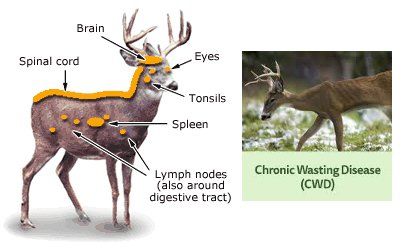
To piggyback off deer season, I thought I’d touch on a real concern, Chronic Wasting Disease, or CWD. This disease affects the deer and elk population in South Dakota. CWD causes infected deer and elk brain tissue to break down and become sponge like. Once this happens, the animal loses some of its survival instincts and becomes more vulnerable to predators or to catching other diseases like pneumonia and then ultimately dies.
SD Game, Fish and Parks claim there is no current evidence that CWD can infect humans, even if we eat the venison from an infected deer or elk. They go on to say that if we suspect a harvested deer or elk has CWD, we should contact GF&P and submit a sample. I have no clue what the sample entails.
What is alarming to me is that the first case of CWD was in Fall River County in 2001. Since then, it exists in free-ranging elk and deer in Fall River, Custer, Pennington and Lawrence counties. In these counties, from 2001-2019, CWD has been confirmed in 135 whitetail deer, 89 mule deer, and 201 elk.
So now what? GF&P is drafting an action plan that will be presented at the next GF&P Commission meeting, scheduled for July 8 and 9 at the American Convention Center, 3112 Farm Island Drive, Ft. Pierre, SD. Start time is 1 pm on the 8th, with public testimony at 2 pm. After that, CWD is on the agenda, but I’m not sure where, or what time. You can submit written comments to CWDActionPlan@state.sd.us.
Economically, Game, Fish, and Parks has a 56 million dollar budget, which is half funded by license sales. The other half is funded from federal excise tax paid on guns, ammunition, archery equipment, fishing gear, and boating fuel.
Collectively, anglers, hunters, trappers, wildlife viewers, boaters, state park visitors, and snowmobilers spend $1.3 billion in SD annually. In South Dakota, deer hunters spend more than $160 million annually. There are over 70,000 deer hunters and they drive an industry with about 3900 jobs and approximately $125 million in wages across the state.
Game, Fish, and Parks, I believe, is being as pro-active as possible on getting out ahead of Chronic Wasting Disease, and I applaud their efforts.
To the citizens of District 30 and to the men and women in uniform, in honor of all who served, in respectful memory of all who fell, and in great appreciation to those who serve today, Thank You, for giving me the opportunity to serve you.
Tim R. Goodwin, District 30 Representative